-->

Sunday, October 29, 2017

Verdigris Painting Tutorial


A long time ago I was experimenting a lot with getting just the right combination for painting patina/verdigris on my models, namely Grave Guard and Black Knights - and that was before Nihilakh Oxide was a thing. Eventually, I got the thing right, wrote down the recipe and used it successfully on Krell. Then, when I was working on Nagash and the Wight King I managed to make photos and prepare a whole tutorial describing the whole thing. Since then I used it also on the converted Necrosphinx, more such projects will come up in the future.

And before I start, let's clear this thing - I use old paints so if it's unavailable - use this conversion chart

First - I mixed paints you see below, with TinBitz:Gunmetal (Warplock Bronze:Leadbelcher) ratio being about 2,5:1 or maybe 2:1 - the effect was as pictured:


I added about the same amount of water as the paint to make it thinner and easier to use. A single coat was enough to achieve a smooth finish.


Next, I made some turquoise - I don't really have turquoise paint so I mixed it. Last time I used following recipes:

Dark turquoise
  • 1 part Dark Angels Green (Caliban Green)
  • 1 part Regal Blue (Kantor Blue)
  • 12 parts water
  • 2 parts Vallejo Glaze Medium (can be replaced with water)

Light turquoise
  • 1 part Goblin Green (Warboss Green)
  • 1 part Enchanted Blue (Caledor Sky)
  • 1 part Skull White (White Scar)
  • 12 parts water
  • 2 parts Vallejo Glaze Medium (can be replaced with water)

In the end, you should get something like this - if not, adjust the amounts of green and blue to your preference:


The paint should be pretty thin, covering the metallic parts only slightly, flowing into the recesses. I am also using a bit of Vallejo Glaze Medium in the mix because it makes the whole mixture flow and dry a bit smoother, but it should work with just water too. I was putting both colors on the minis, light on larger surfaces and edges and dark in the creases - wetblending them in the process. Don't worry about precision, it should be messy at this stage. Before drying:


After drying mostly:


When this dried I painted them once again - this time with light turquoise only and putting it rather on raised surfaces and edges - and being untidy and quick with it - it doesn't need to be neat and clean. The thickness of the paint should be the same as on the earlier step, so if you have some remaining, that's perfect. Wight King and Nagash after this phase:


When this dried I tried stippling it with white paint - with this brush:


I begin by taking a bit of white paint on the brush and then wipe it on a piece of towel until it's dry - just like with drybrushing - but rather than brushing the mini, I poked it vertically. It leaves little, untidy points which makes it look quite weathered.


At this point, it looks rather acceptable, especially if you stipple the things a little tidier and dryer (I knew the next phases will cover it up and profit from messiness). Patina Overload.

Next, I took Tin Bitz (Warplock Bronze) and stippled the mini with this - only this time I didn't bother drying the brush completely, it should still have quite a bit of paint on it. Stippling it like that was leaving large, untidy spots with some rough texture to them. I left creases and dents in armor, focusing on the exposed and raised parts - covering them with the paint roughly and untidy. At this point, you can add some gold details that will make some parts pop out after the last phase. Nagash's crown after adding Tin Bitz and Vallejo Old Gold.


After this, I stippled it again - using white and really dry, the same as earlier. This left on the mini a mix of points in turquoise, tin bitz and white - with turquoise in the creases, tinbitz on raised surfaces and edges and white dots as little accents. The difference is subtle, so I didn't make a photo - but don't omit it, because those tiny dots help in the last phase.

And finally I used the light turquoise paint once again - you can use the same recipe, only this time use 16 parts water and 3 Vallejo Glaze Medium, it should be much, much flowier. Using this mix, I washed the whole armor completely. And this was the point when stippling turned out to be a great discovery! You see, all this stippling left a rough texture on the mini - and wash rather than just flowing into the creases, was also leaving its mark on the surfaces, making clots and spots - all of them quite random and very weathered. And this is how the minis on the top picture came out to be. I was surprised and very pleased with the result.

The final result on the Wight King and Nagash's crown:


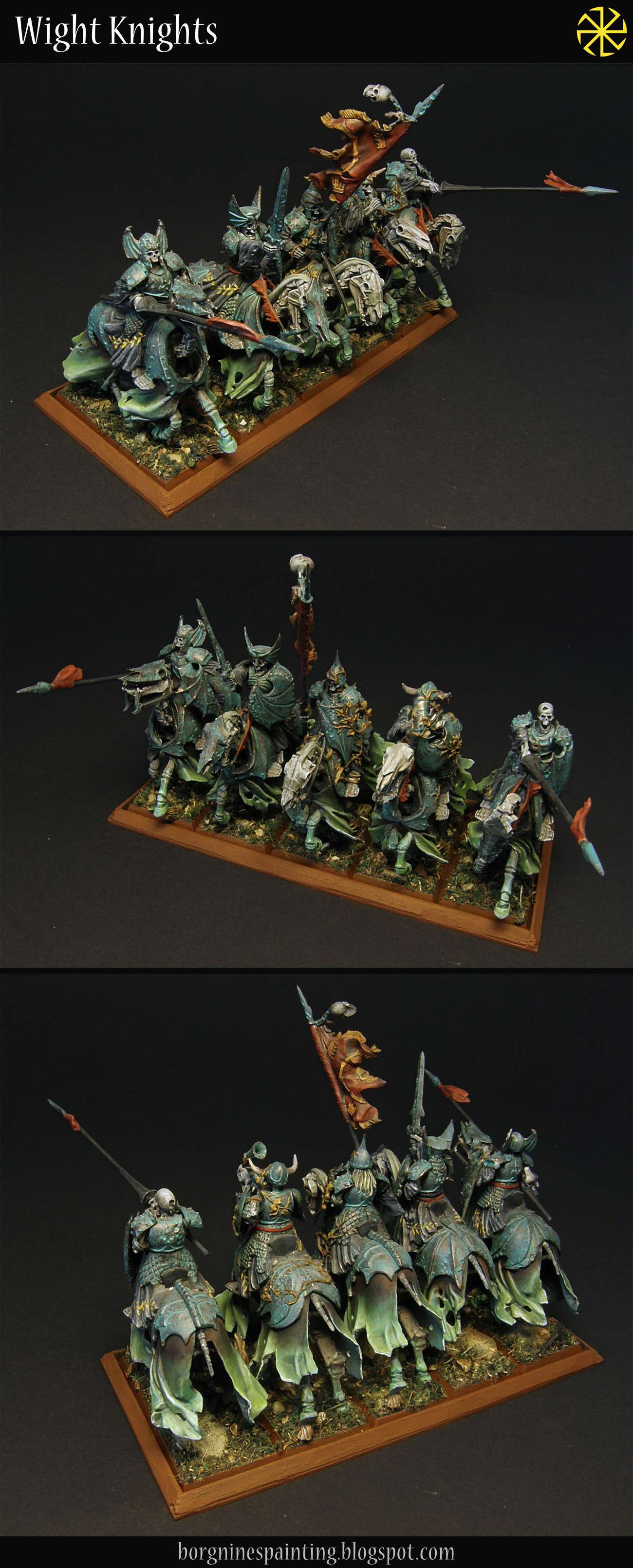
Wight Knights

Black Knights from Games Workshop, painted in September 2013. I tried to paint their horses to look part-spectral - thus the green parts on their barding - all to make them fit the rules and fluff of the game. Today I dislike that look and when I'll be doing more of those, I'll strip paint at least off those horses. As described in the fluff, I intend to give them some kind of heraldic symbols on the barding. Time will tell how that will go.


In another tomb, the cavalrymen of the ancient Varsavia were found. Buried along with their horses and barding, they rode again after being raised. While warriors themselves were definitely substantial, their steeds shifted into some spectral realm, allowing them to easily traverse Varsavian forests and marshes. Each one of the warriors bore an intricate, yet dulled, symbol on their barding - these were like heraldry and signified honored soldiers in the armies of the ancients. Extremely loyal warriors, they demanded to be brought to one of their chieftains. In the absence of such, they were pressed into the vampires' armies as really effective shock troops.

https://i.imgur.com/3BW0FpK.jpg

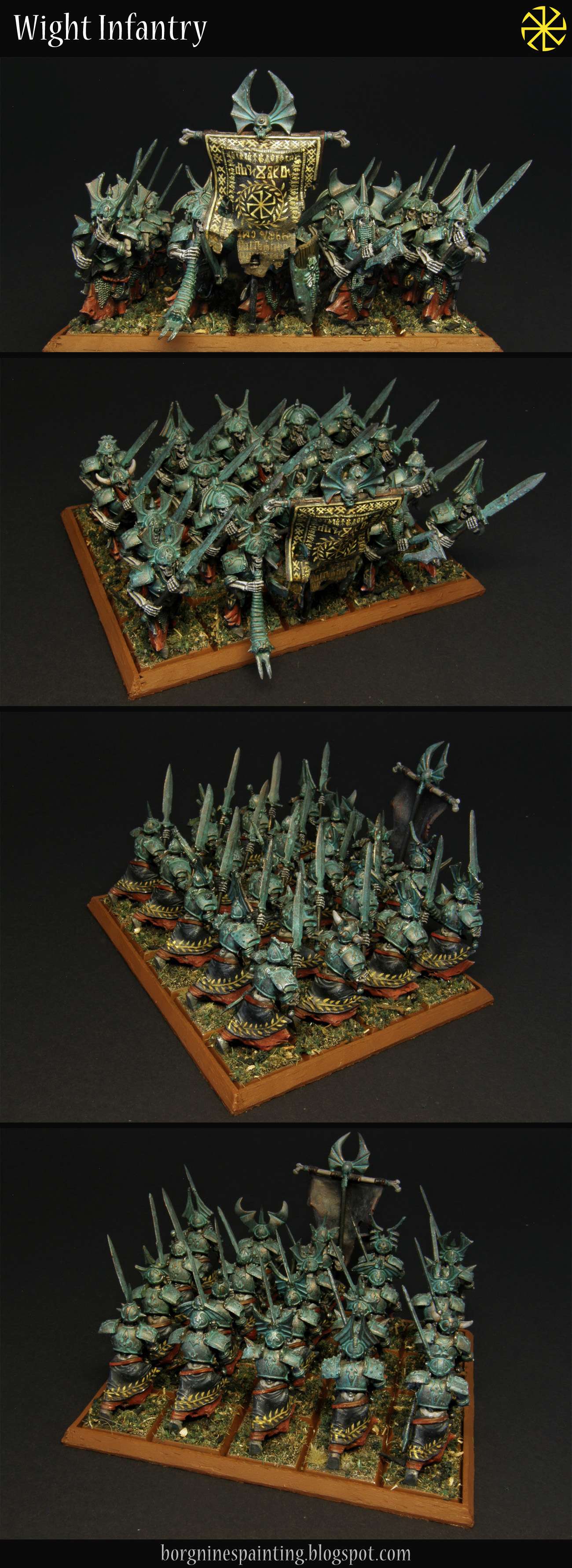
Wight Infantry

Grave Guard wights from Games Workshop, painted in September 2013. When I was painting them I still didn't have a theme for the whole army - only a vague green color scheme. First I wanted to make them look a bit roman - and all that's left of that idea are the laurels painted on their robes. I also made their armor patinated teal, to make them fit the greenish scheme - it was also quite easy to paint. Those two things became the defining characteristics of my wights and other units belonging to the 'Ancient Varsavians' faction.


After returning to Varsavia, von Greifens found out that many hundreds of years ago, a peculiar death cult was strong in these lands. Interested in the old necromantic ways they may have been practicing, they finally found a tomb filled with dried skeletons of ancient warriors, still with their patinated armor and weapons. Brought into unlife with the help of Alexander Hautfell, these wights proved to be much more than mere skeletons. Their grayed bones were unnaturally tough, their grip stronger than that of a living person and most of all - they retained some of their old thoughts and memories. They were the sworn warriors of a death god which name was lost to history and fought in Varsavia when there was no Empire or Kislev and beasts thought to be mythical roamed the forests. While they posessed their old wills, necromancers were still able to at least bend them to serve them to some extent. Their cursed weapons and drilled discipline made them most useful warriors.

https://imageshack.com/a/img924/2482/jUTIe2.jpg

Sunday, October 8, 2017

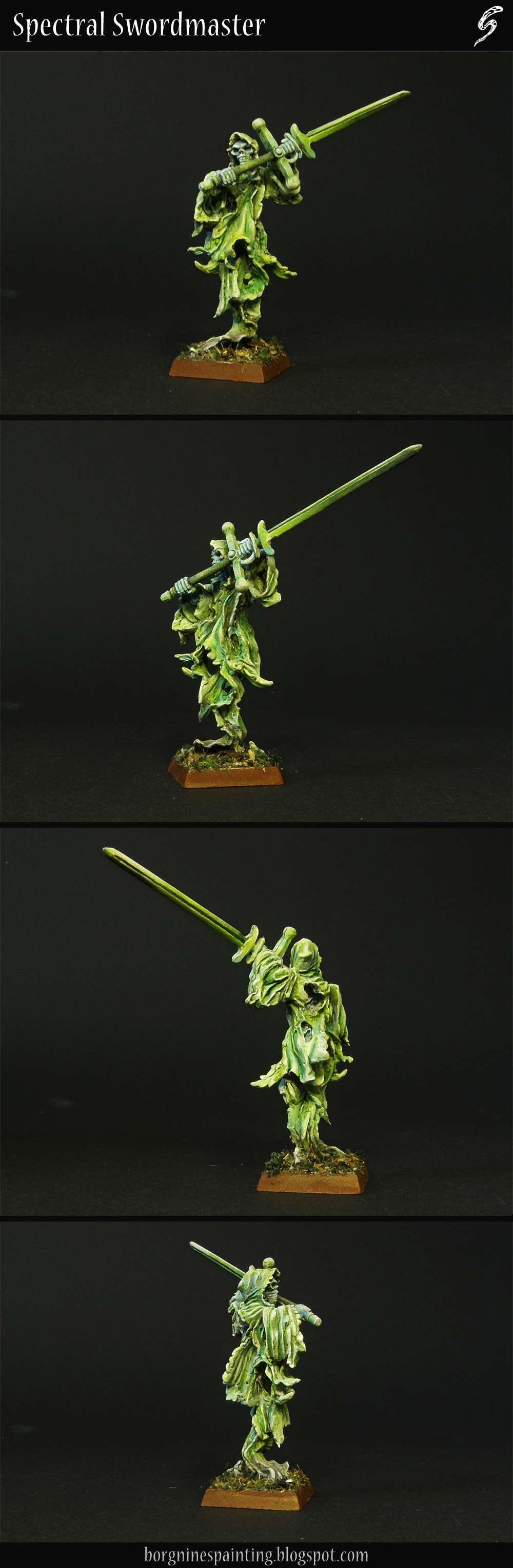
Spectral Swordmaster

A 'Spectral Minion' from Reaper Miniatures, metal model painted in August 2013. I bought it to serve as a Cairn Wraith in my army - they normally use giant scythes as weapons, but the rules say those are 'Great Weapons', so I thought, why not a giant sword? The painting was done very quick, some wetblending, some highlights, just blue and green. The sword itself was a bit challenging, to get that gradient on the blade. A nice little project.


This ghastly apparition was brought to unlife when several maddened spirits of swordsmen killed by Lucan melded into one furious wraith. It attacked the vampire in his own room, nearly slicing him in two with one swing. The warrior retaliated - the ensuing battle lasted for a whole night and resulted in immense damages in the castle. After some time, Lucan was able to gain the upper hand and bound the spirit using necromantic rituals. Being brought to existence by the hate it felt to him, now it was bound in servitude to him - a pitiful existence. Should anyone free the ghost of its servitude, it would be a nasty surprise to the vampire.

https://imageshack.com/a/img921/7215/NwsHm9.jpg

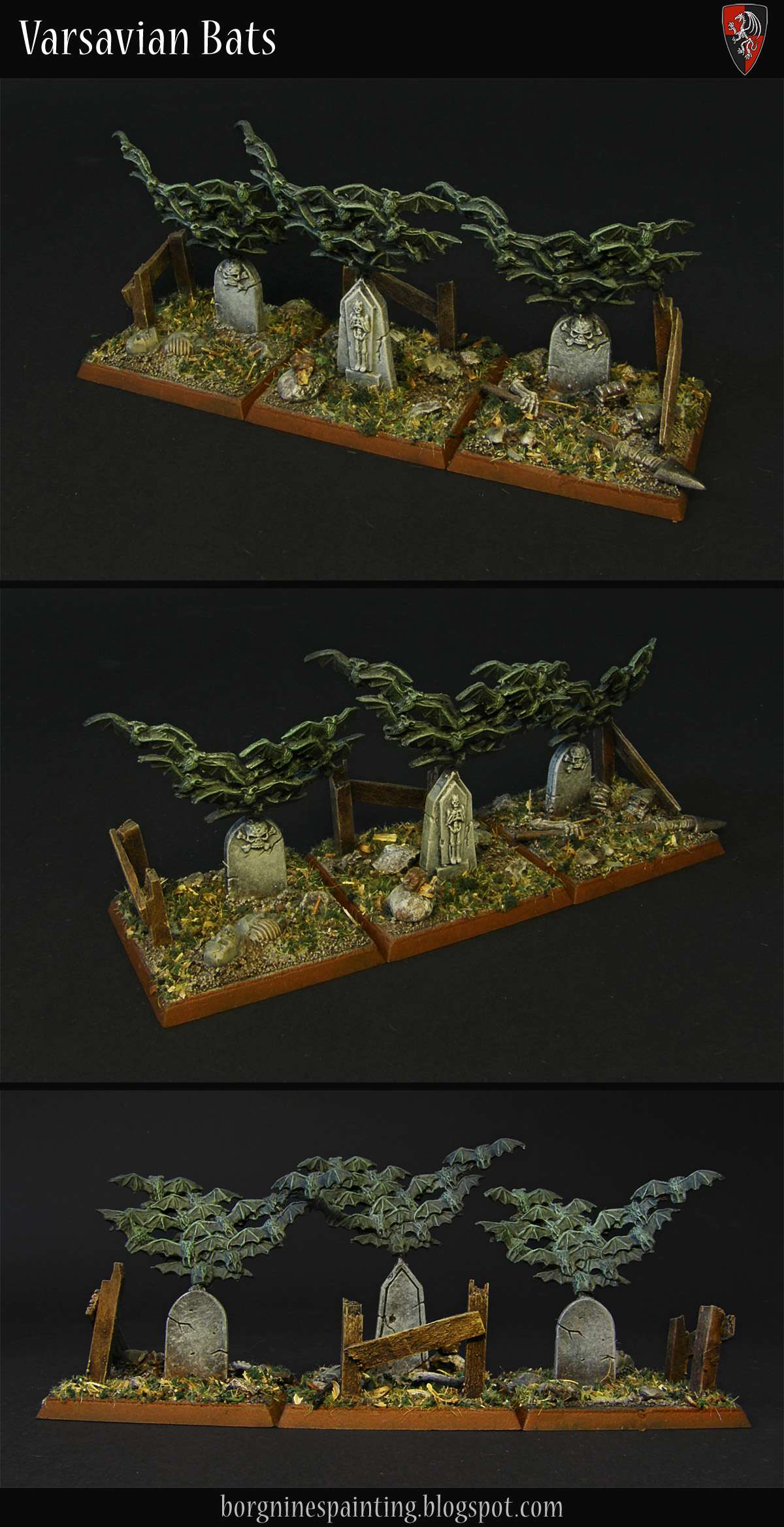
Varsavian Bats

Some bat swarms painted in August 2013. Models are from Mirliton SG. I bought them because I wanted to use them in the game, not necessarily because the models were especially pretty... Originally they were completely flat, so I bent them a bit to make them less flat... but they are still kinda flat. Back in the day, those were my most elaborate bases ever! Fences are made of balsa wood and gravestones are plastic.


Bats were always drawn to those blessed with the vampiric blood and they, in turn, were fond of using bat images in their visual arts. Thanks to that blood bond, even lowly vampires are able to summon some amount of them. Bats of Varsavia weren't as big as those of Sylvania, but they are still eager to do their part by creating a chittering, biting and confusing cloud of creatures around the vampires' enemies.

https://imageshack.com/a/img922/2851/nr0KuG.jpg

Friday, October 6, 2017

Ecaterina Sokolov

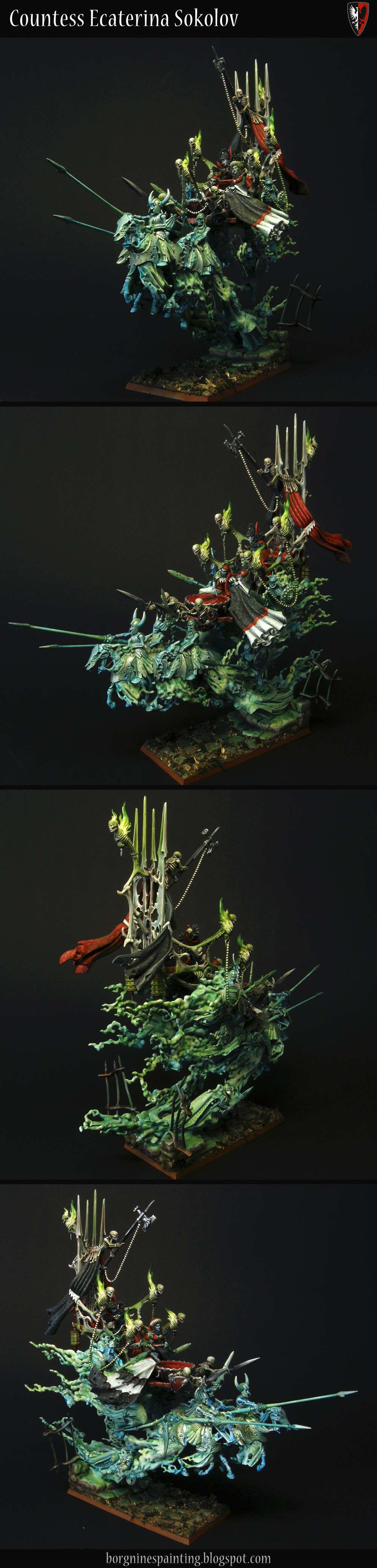
The Coven Throne, a rather big vampiric chariot finished in March 2017 - plastic from Games Workshop. That was a hell of a project, took quite some time. Challenge for the mini was to really push the red-black-white scheme to the max. It works for the carriage itself, but it gets lost in all those green spirits. But still, in the end, it was all kinda worth it. You can see the WIP post HERE- with the subassemblies and some techniques described.
First are the photos of the whole model.


After returning to their ancient homeland in Varsavia, von Greifens found themselves at odds with another vampire that rose to power during their long absence. A small, bloody court was held here by Lady Ecaterina Sokolov - once a wife of a Kislevite Boyar, now a vampire countess on the lands of Varsavia. Yet despite her pride, her position and forces seemed weak, which provoked brother’s attack. They came out victorious - only barely, though. She kept her own domain in which she still rules unquestionably, together with a personal army - and von Greifens were obliged to defend that land. In exchange, Brothers were free to govern and expand Varsavia as they liked. Before both parties concluded their meeting, the Countess shared a secret with the newcomers - information an ancient Varsavian death cult, which much later led to unraveling the story of wights and their Death God, changing the local balance of power forever. Ecaterina herself, when enraged by something personally, brings down her wrath from upon an exquisite throne loft upon by ancient spirits and accompanied by her two most loyal handmaidens.

https://imageshack.com/a/img921/8149/0Ma4P0.jpg

And some close-ups.

https://imageshack.com/a/img923/2626/bX3A3j.jpg

Saturday, September 30, 2017

Ecaterina Sokolov - WIPs

EDIT: The finished model can be seen HERE.

In December 2016 I slowly started putting the Coven Throne together. The whole model is impressive enough, so the conversions I planned were rather small. 


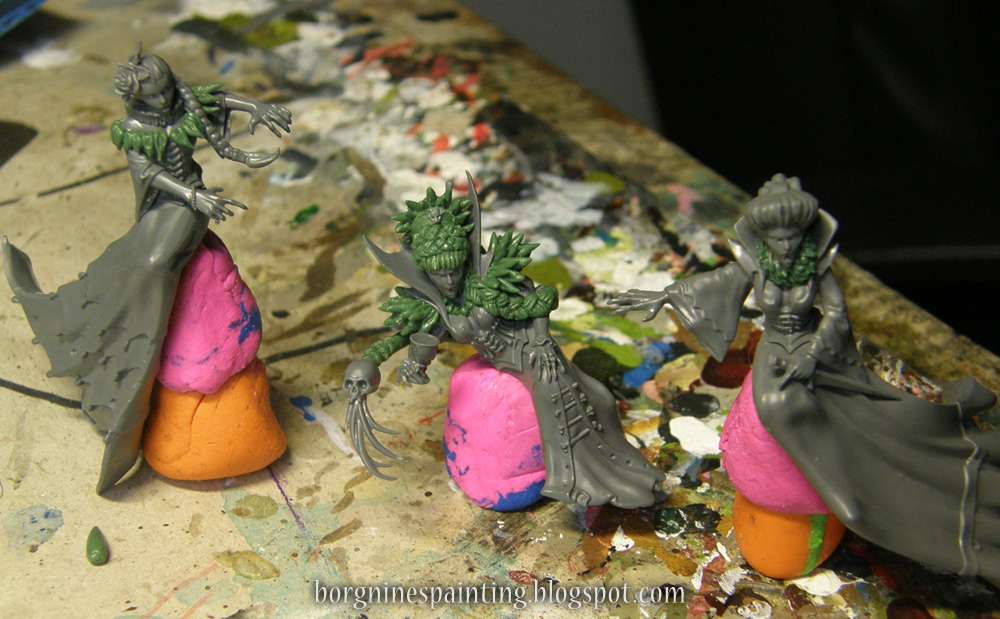
First, I gave the Countess a new haircut (inspired by THIS picture) and her handmaidens got some fur trims on their clothes. The plan was to make them look a bit like old russian nobility.

https://imageshack.com/a/img922/3619/J0dBlF.jpg

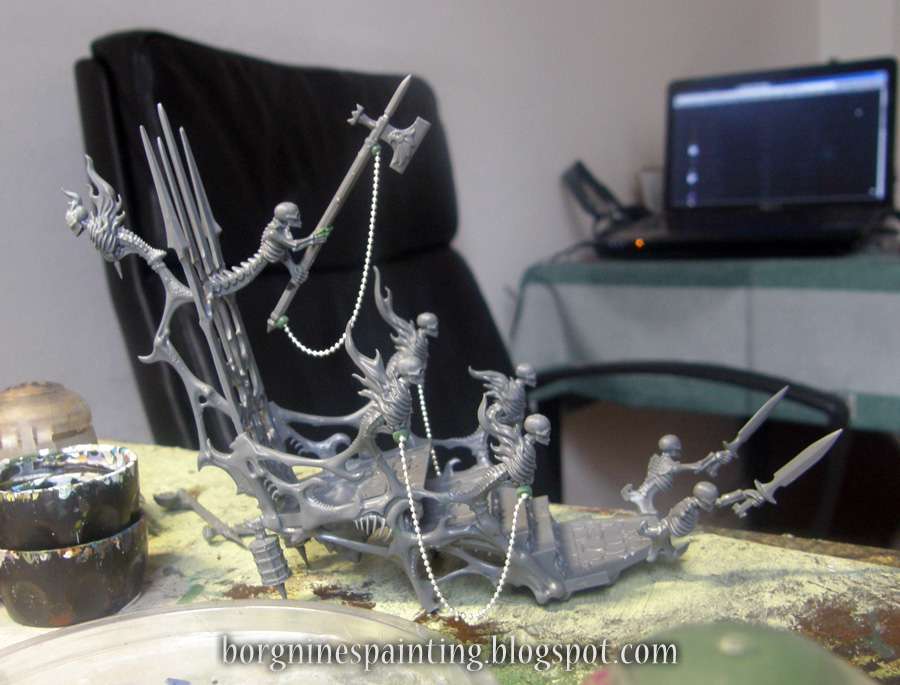
The project kept growing while I was working on it. While looking for inspiration on russian noblewomen, I noticed that they used a lot of pearls. So I ordered 1mm ball chain and used it to add pearls to the whole carriage. ALso, the commoner scythe in the skeleton's hands was replaced with a much more noble halberd.

https://imageshack.com/a/img921/8900/YuYWub.jpg

Then, the base. I wanted the Countess to be both connected to the forest theme the rest of the army has and also be somehow more civilized. So I planned a stone path coming from her palace into the forest - the idea with the bent fence came a bit later. I joined some bent and cut nails with drilled sprue pieces and then held it carefully over fire to make the plastic bend too. Maybe it's not as wide as a proper entrance to the forest, but it works much better than my first idea - having the ghosts phase through the fence. That doesn't really work without translucency.

https://imageshack.com/a/img921/1350/7jw5bf.jpg

Next, the spirit horde. It was a big challenge to make the normal ghostly parts different from the metal parts while still keeping them distinctly uniform. In the end I painted ghostly parts white, metal parts light silver - and then glazed it all with blue and green. The effect is subtle, but that's what I needed. There are some freehands on the robes, but that's also very light. The whole thing was quite a pain to reach everything with the brush.

https://imageshack.com/a/img924/6277/MVFt3S.jpg

Now, the carriage itself. As most of my vampires, Countess and her entourage are kept in the black-red-white colour triad - except any special effects that is. The whole carriage was thus a one big excercise in painting everything in those three colours. It was a bit demanding, but turned out okay in the end.

https://imageshack.com/a/img921/8607/IkfDNw.jpg

And as the last WIP picture, the Scrying Pool. I wanted to paint an image there, because the background in the book describes it like that and I never seen anyone doing it on this model. My first attempt (above) was rushed, sloppy and flat. Next one took much more time but also turned out much better.

>